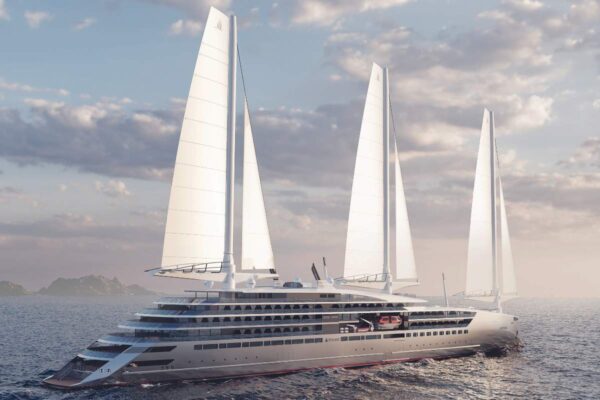
SeaDream Innovation to set new standard in sustainability at sea

Launching in 2021, the new mega-yacht has been classified as the world’s most advanced hybrid ship and will sail to all seven continents.
A sustainability-led approach to energy and climate technology has been the focus of SeaDream’s latest ship, SeaDream Innovation, deemed to be the world’s most advanced hybrid ship being built today.
The cruise line received a grant for $1.8 million (approx. £1.4 million) from Enova – an organisation dedicated to the development of energy and climate technology – for the creation of its new mega-yacht, which will feature with the most advanced hybrid systems to enable it to sail to all seven continents, including areas which are more sensitive such as the Norwegian fjords and along the ice edge towards the North Pole. 
Equipped with a large battery pack of approximately 4 MWh, this will allow it to sail silently and without emissions for up to three hours. The hybrid system will reduce local emissions by supporting the diesel generators in “peak shaving mode”, reducing fuel consumption. The batteries will also act as “spinning reserve,” which in the event of a motor shutdown will switch instantaneously to the use of batteries without loss of power.
The ship will also be powered by four modern diesel engines and a Selective Catalytic Reduction (SCR) system for reducing nitrous oxide emissions.
An “Organic Rankine Cycle” installed in SeaDream Innovation will take waste heat from the engines and convert it to electricity. By utilising this electrical power, it will reduce fuel consumption and result in lower emissions.
Wherever possible, SeaDream Innovation will be plugged into shoreside electrical grids in ports around the world by using a multi-voltage shore connection system, thereby reducing local pollution. Other environmentally-friendly features will include two podded propulsors for efficiency and maneuverability.
Enova’s CEO Nils Kristian Nakstad notes how, while batteries have entered into the maritime sector, it has rarely been put into practice, especially on cruise ships, along with electrical power. He comments: “When it comes to electricity production of surplus heat, land-based industry has shown what is possible, but at sea, such solutions are currently used very little. We depend on more people developing and using these technologies the world needs.”
Commenting on its latest ship, Atle Brynestad, owner of SeaDream, said: “We are proud to contribute to the cruise industry by taking the lead in developing more environmentally-friendly vessels that will also sail with the Norwegian flag. We are committed to having a positive impact on the environment, our employees, our guests, our suppliers and the places we visit.”
He continued: “In the future, we all need to make a positive contribution to our environment and the local communities we visit, so guests can continue experiencing different local communities and enjoying the fantastic nature while using local services and making local purchases where possible.”
In recent years, cruise lines have been making serious waves to minimise their environmental impact and to implement environmentally-friendly practices. For six of the best green cruise lines today for eco-conscious clients, see Jill Sayles guide.